Have a 'kitto katsu'? How KitKat went from British snack to Japanese fave
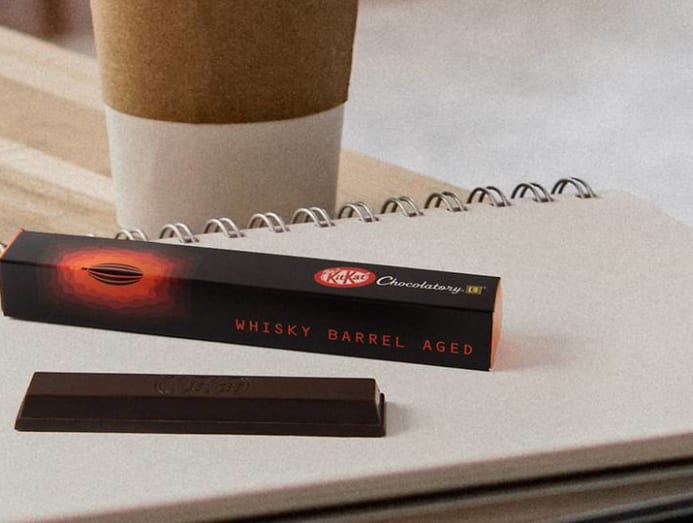
In December 2020, Nestle, the Swiss chocolate company based on the scenic shores of Lake Geneva, launched an online advertisement campaign in Japan for a "whisky butt aged" KitKat.
Its iii layers of wafers were coated with chocolate made from "rare cacao nibs" aged for 180 days in whisky barrels from the island of Islay – "sacred ground" in Scotland for the drink, or and then the Japanese marketing literature said.
This apparently gave the bar "a refined whisky aroma . . . and evokes a at-home and relaxed feeling".
Does this sound weird or wonderful? Is it a display of culinary creativity by Japanese patissier Yasumasa Takagi, who developed the recipe? Or is it just a sign of the gimmicks that consumer goods companies will apply to chase margins? Possibly all of the above.
But hither is another mode to interpret that Scottish-Swiss-Japanese innovation: As a symbol of the paradoxical nature of globalisation today – ane that might signal to how we consider cultural identities, labels and multifariousness. We live in an era marked past once-unimaginable levels of global interconnection, ushered in partly by digitisation.
That, after all, is the reason chocolate made from cacao aged in Scottish whisky barrels can be advertised then easily to Japanese consumers – and also discovered past me, an English announcer living in New York.
'JAPANESE' SUSHI, 'AMERICAN' HOTDOG
Even so every bit digital platforms, cargo ships and planes create connections (and contagions), nosotros are also living through an anti-globalisation backlash, fuelled past economic pain, geopolitical tensions, populism and insecurity in the face of rapid technological alter.
Many communities are trying to define their differences – or tribal allegiances – by embracing distinctive cultural signifiers, whether a flag, a linguistic communication, national wearing apparel or a passport.
Food can reflect this: Hot dogs, say, seem "American"; sushi, "Japanese". But the beauty of what nosotros eat and beverage is that it signals an oft-overlooked truth: While national labels can be powerful, they are rarely as fixed as people remember.
On the contrary, what we feed ourselves with reveals that we live in a world where identities can be wonderfully fluid and ambiguous.
In the 20th century, some social scientists fretted that the world was heading for "Cocacolonisation": in which brands such as Coke dominated, crushing local competitors, in an expression of western corporate and political power.
But what observers realised subsequently was that this stereotype does not begin to capture what globalisation actually does. Yes, cultural memes and objects spread: Coke bottles are establish everywhere. But meanings change when they jump borders.
"Coke is often attributed meanings and uses within particular cultures that are very unlike from those imagined by its manufacturer," David Howes, an anthropologist, has written. These include smoothing wrinkles in Russia, turning copper into silver in Barbados, and reviving someone from the expressionless in Haiti, he noted.
Moreover, cultural trends do not motion in i direction: Equally Birmingham's balti curries and California'due south avocado-laden "sushi" rolls testify, they ebb dorsum and along between countries and cultures, creating new fusions all the fourth dimension. When you lot look at a whisky barrel aged KitKat, in other words, y'all are not just seeing a chocolate snack.
'THE BIGGEST Piffling MEAL IN BRITAIN'
KitKat's by offers clues to its globalised present. In 1862, a Quaker patriarch called Henry Rowntree bought a cocoa works in York, in the northward of England. He shortly moved it to an unlikely location – a one-time industrial atomic number 26 foundry – and built a family unit sugariness-making business concern with his brother Joseph. They later hired a French confectioner to develop recipes.
In the 1930s, the visitor launched the milk chocolate-covered wafer we now know as the KitKat afterward an employee suggested Rowntree'southward develop a care for "a homo could take to work in his pack".
Wartime austerity forced a alter in recipe and branding, only when life returned to normal KitKat'south popularity boomed, under the tag "The biggest little meal in Britain". Rowntree's started exporting it to former British colonies. Its slogan, invented in the late 1950s, endures today: "Accept a break, have a KitKat."
When KitKat arrived in Japan in the 1970s, information technology was sold as an exotic "British" care for to consumers who were developing a gustatory modality for foreign travel. Adverts in Japan showed "British people in distinctly British environments enjoying a KitKat break betwixt action-packed activities," explained Philip Sugai, a business school professor in Japan, in a case study. "The bulletin revolved around how Japanese people could enjoy life inside the British context."
Yet despite being backed by the marketing musculus of multinational Nestle, which acquired Rowntree's in 1988, KitKat struggled to compete with confectionery from local producers such as Glico.
"KitKat was seen as a strange sweet and didn't look similar it would ever exist that popular," said Ross Rowbury, former president of public relations agency Edelman Japan.
Indeed, past the turn of the millennium, executives at Nestle's regional office in Kobe, Japan, were asking themselves whether the KitKat brand had a time to come in the country. Nestle thought the best way to heave sales was to target students.
'YOU Volition OVERCOME'
But the company'southward ethnographic "fly-on-the-wall" inquiry revealed Japanese teenagers did not like the "Take a break" tag. These students were so stressed by juken – the high-pressure level exams that accept such a bearing on their futurity – that the merely "practiced intermission" they wanted was a long rest, not mere chocolate.
But so came a twist that no western corporate planner could have foreseen – or at to the lowest degree not with top-downward economic models and consumer polls. In the early 2000s, Masafumi Ishibashi, a local Nestle manager and his boss, Kohzoh Takaoka, heard that sales of KitKats on the southern Japanese island of Kyushu were surging between December and February.
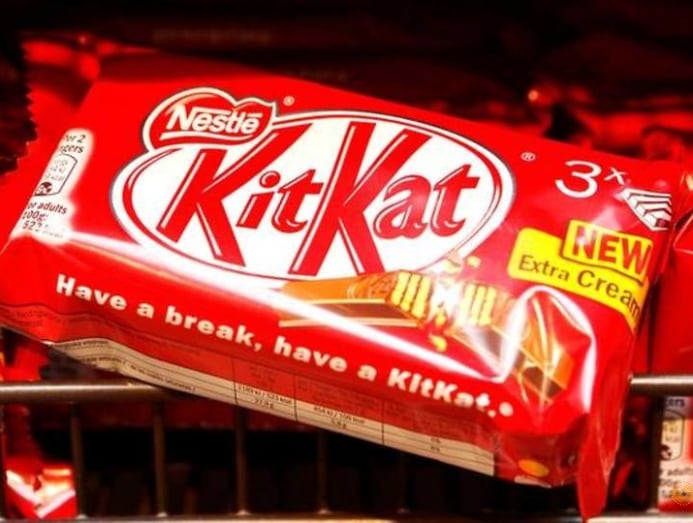
A tendency had erupted amongst teenagers: Students had noticed that the word "KitKat" sounded like the Japanese phrase "kitto katsu" ("y'all volition overcome"), so they were giving each other the bar as a adept-luck token to go through the ordeal of juken.
Initially, this seemed nothing more than a piece of teen trivia. The Kobe team did not dare replace the "Have a break" tag with "Kitto katsu" since they knew their bosses in Switzerland wanted to maintain consistency amid global brands.
Merely Takaoka, Ishibashi and the rest of the team decided to endeavour some subtler tactics to capitalise on the student craze and spread it across Kyushu. They put the phrase "Kitto sakura saku yo!" ("wishes come true!") in their Japanese adverts and asked hotels adjacent door to exam centres to distribute KitKats to students with this slogan on a postcard.
The wording was acute: Literally, it ways "the cherry blossoms will blossom". "Considering of the revered position that the ruddy blossom season (holds) in Nippon, blooming ruddy trees (are) equated with abundance and success," Sugai wrote in his case study.
Ishibashi adds: "We didn't exactly tell Vevey (Nestle headquarters) what we were doing, considering we knew that it would sound and so strange (to not-Japanese people). We wanted to start quietly and see if it would work."
KITKAT AS A Practiced-LUCK CHARM
It did: Sales of KitKats exploded among students across Japan. Teenagers redefined the bar every bit an omamori, the adept-luck token sold at Shinto shrines and Buddhist temples. In January 2003, 34 per cent of Japanese teenagers told pollsters that a KitKat was their favourite good-luck charm, 2nd simply to an omamori blessed past a 18-carat Shinto priest. "It was amazing," recalled Ishibashi. "(Chocolate) became an omamori."
Eventually, the Japanese squad told their bosses in Vevey what was going on. Wisely, executives in Switzerland allowed the team to proceed with their cultural experiments. In Kobe, the KitKat packaging was redesigned to enable students to write good-luck messages on it, and then Japan's mail service was persuaded to accept them as prepaid envelopes. "Nobody had e'er done that before with the postal system," observed Sugai.
When Fukushima in eastern Japan was hit by a tsunami in 2011, people sent KitKat boxes to the workers tasked with reconstruction as a form of encouragement. Later, special boxes fifty-fifty became valid as train tickets under a scheme to boost tourism to Fukushima.
Nestle's Kobe squad broadened their experimentation beyond marketing. To United kingdom of great britain and northern ireland consumers, a KitKat was a brown chocolate snack bar, but in 2003, the Kobe team created a pink KitKat by adding strawberry pulverization. They then fabricated ane with matcha (green tea) pulverisation.
To engagement, they take created more than 300 local flavours, including wasabi, soy sauce, sake and even, in 2017, a limited-edition pharynx-lozenge season to soothe hoarse Japanese football fans cheering on the national team in the Earth Loving cup qualifying campaign.
A few of these innovations embraced non-Japanese flavours as novelties. However, most expressed a sense of Japanese identity through food. Over fourth dimension, flavours became embedded in Japan's regional identities also, such as purple sweet tater from Okinawa or cheese from Hokkaido. These are now sold as tourist souvenirs (omiyage) at Japanese railway stations.
To British or Swiss tastes, such flavours can seem strange. Indeed, strange tourists often purchase them as souvenirs of Japanese, as opposed to British, culture. But foreign or not, the craze had turned the bar into one of the top-selling chocolate brands in Nihon.
Light-green TEA CHOCOLATE IN THE Great britain
The KitKat'southward ascension there was and so dramatic that Ryoji Maki, ane of the Kobe executives who had introduced the wild new flavours, was promoted to KitKat's global brand manager in Vevey.
Then came the final twist: Nestle launched the matcha KitKat in the Britain, where it sold fairly well. Strictly speaking, this was non a made-in-Japan import: The bars are manufactured in Germany. But green-tea chocolate (the KitKat confined themselves are green) was not something British consumers could have imagined 50 years agone.
"What this story shows is that you have to recall outside the mainstream," Maki told his baffled not-Japanese colleagues at a presentation – showing pictures of Japanese students clutching KitKat bars every bit omamori during exams. "Y'all have to listen to consumers." Or, more accurately, recognise that consumer tastes are more creative than executives might sympathize.
Would the Rowntrees have canonical of all this? I like to think so. Victorian England, after all, was another menses of globalisation, when trends collided across borders, admitting often nether unequal circumstances. Equally entrepreneurs, the Rowntrees knew that commercial success relies on having a flexible mind and being willing to pinch practiced ideas from any source.
Therein lies the biggest point of all – not so much about our gustation buds but about how nosotros imagine identity today. The 21st century is a fractured time when politicians promote narrow nationalisms, draw boundaries between "us" and "them" and express antagonistic cultural allegiances.
But what the journey of KitKat, like so many other foods, shows is that labels tin can too be malleable, in a good way.
Whatever yous think of whisky barrel aged KitKats, we tin all gloat the fact that a brown chocolate bar has turned light-green, and become Anglo-Swiss-Scottish-Japanese forth the fashion. Let us hope information technology tin be a metaphor for politics as well.
Past Gillian Tett © 2022 The Fiscal Times
Source: https://cnalifestyle.channelnewsasia.com/dining/kitkat-chocolate-history-japan-matcha-wasabi-flavour-258246
0 Response to "Have a 'kitto katsu'? How KitKat went from British snack to Japanese fave"
Postar um comentário