Records of the Gates Families of America From the Colonial Period
"Colonial America" redirects here. For other uses, see Colonial America (disambiguation).
Template:Morefootnotes
| History of the U.s. | |
 This commodity is part of a series | |
| Timeline | |
|---|---|
| Pre-Columbian catamenia | |
| Colonial period | |
| 1776 – 1789 | |
| 1789 – 1849 | |
| 1849 – 1865 | |
| 1865 – 1918 | |
| 1918 – 1945 | |
| 1945 – 1964 | |
| 1964 – 1980 | |
| 1980 – 1991 | |
| 1991 - 2001 | |
| 2000s | |
| Topic | |
| Westward expansion | |
| Overseas expansion | |
| Diplomatic history | |
| Military history | |
| Technological and industrial history | |
| Economic history | |
| Cultural history | |
| History of the Southward | |
| Ceremonious Rights (1896–1954) | |
| Civil Rights (1955–1968) | |
| Women's history | |
| LGBT rights in the U.s.a. | |
| United States Portal |
The term colonial history of the United states refers to the history of the land that would become the U.s.a. from the get-go of European settlement to the time of independence from Europe, and particularly to the history of the xiii colonies of United kingdom which declared themselves contained in 1776.[1] Starting in the late 16th century, the Castilian, the British, the French, Swedes and the Dutch began to colonize eastern Due north America.[2] Many early attempts—notably the Lost Colony of Roanoke—concluded in failure, but successful colonies were shortly established. The colonists who came to the New World were not alike; they came from a variety of unlike social and religious groups who settled in different locations on the seaboard. The Dutch of New Netherland, the Swedes and Finns of New Sweden, the Quakers of Pennsylvania, the Puritans of New England, the English language settlers of Jamestown, and the "worthy poor" of Georgia, and others—each grouping came to the new continent for different reasons and created colonies with distinct social, religious, political and economic structures.[iii]
Historians typically recognize iv distinct regions in the lands that later became the Eastern United States. Listed from north to south, they are: New England, the Middle Colonies, the Chesapeake Bay Colonies (Upper South) and the Lower Southward. Some historians add a fifth region, the frontier, as frontier regions from New England to Georgia resembled each other in sure respects. Other colonies in the pre-United states of america territories include New French republic (Louisiana), New Spain (including Florida, California, Arizona, New Mexico, Texas, Nevada, Utah and parts of Colorado and Wyoming), Columbia District (Washington country, Oregon and northern California) and Russian Alaska.
Contents
- i Motives for colonization
- 2 Early on colonial failures
- 3 Spanish colonies
- three.1 Florida
- iii.2 New Mexico (1598-1821)
- iii.three California (1765-1821)
- 4 New Netherland
- 5 New France
- 6 Russian colonies
- 7 British colonies
- 7.1 Convict settlers
- 7.2 Chesapeake Bay expanse
- seven.2.one Jamestown
- 7.3 New England
- 7.3.1 Pilgrims
- vii.3.2 Puritans
- seven.4 Middle Colonies
- 7.5 Lower South
- vii.v.i Carolinas
- 7.5.2 Georgia
- 7.v.3 E and W Florida
- viii Unification of the British colonies
- 8.1 A mutual defence
- 8.two French and Indian War
- 8.three Ties to the British Empire
- 9 From unity to revolution
- 9.1 Royal Declaration
- 9.2 Acts of Parliament
- 10 Colonial life
- 10.one New England
- 10.1.1 Farm life
- 10.1.2 Boondocks life
- ten.1.3 Civilization and education
- ten.1.4 Religion
- ten.ii Mid-Atlantic Region
- ten.two.i Ways of life
- ten.2.2 Farming
- 10.one New England
Motives for colonization [ ]
The main colonizing regions of Europe were those where body of water-worthy shipbuilding innovations and navigational technology and skills were developing, as well as an expanding population willing and able to establish themselves in foreign lands. The Spanish and Portuguese centuries-quondam experience of conquest and colonization during the Reconquista, coupled with new oceanic ship navigation skills (developed mainly in Italian republic [citation needed]), provided the tools, ability, and desire to colonize the New World. The English, French, and Dutch of northwest Europe were slower to start colonies in America. They had the ability to build ocean-worthy ships, but did non have equally strong a history of colonization in foreign lands as did Espana, although the English language conquest and colonization of parts of Republic of ireland played a role in the subsequently evolution of larger scale colonization efforts As the "New Monarchs" began to forge nations, they acquired the caste of centralized wealth and ability necessary to begin systematic attempts at exploration. Not all exploratory undertakings, however, were done by central governments. Charter companies and joint stock companies likewise played a crucial role in exploration. Espana'due south experience during the Reconquista gave their American colonization efforts qualities of centralized governmental control, military conquest, and religious missionary efforts. In contrast, northwest Europe'due south experience with early capitalism (mercantilism), going dorsum to organizations like the Hanseatic League, gave their colonization of America qualities of merchant-based investment and much less authorities command.
Early on colonial failures [ ]
Kingdom of spain established several colonies in the area that is now the United States. Several of these early attempts failed. In 1526, Lucas Vázquez de Ayllón founded the colony San Miguel de Guadalupe in present twenty-four hour period Georgia or Due south Carolina. The colony but lasted a short while earlier disintegrating. It was also notable for perhaps being the first instance of African slave labor within the nowadays boundaries of the United States. Pánfilo de Narváez attempted to starting time a colony in Florida in 1528. The Narváez expedition concluded in disaster with but four members making information technology to Mexico in 1536. The Spanish Colony of Pensacola in West Florida (1559) was destroyed by a hurricane in 1561. Fort San Juan was established in 1567 in the interior of North Carolina but was destroyed by local Native Americans xviii months afterward. The Ajacan Mission, founded in 1570, failed the adjacent year, very near the site of the subsequently English colony of Jamestown.
The French established several colonies that failed, due to weather, illness or disharmonize with other European powers. A small-scale group of French troops were left on Parris Island, S Carolina in 1562 to build Charlesfort, but left after a year when they were non resupplied from French republic. Fort Caroline established in present-day Jacksonville, Florida in 1564, lasted simply a year earlier existence destroyed by the Spanish from St. Augustine. In 1604, Saint Croix Island, Maine was the site of a short-lived French colony, much plagued by affliction, perhaps scurvy. Fort Saint Louis was established in Texas in 1685, simply was gone past 1688.
The most notable English language failures were the "Lost Colony of Roanoke" (1587-90) in North Carolina and Popham Colony in Maine (1607-8). It was at the Roanoke Colony that the kickoff English child, Virginia Dare, was built-in in the Americas; her fate is unknown.
Spanish colonies [ ]
Florida [ ]
- Chief article: History of Florida
Spain established a lot small settlements in Florida, almost of which were shortly abandoned. The well-nigh of import settlement was at St. Augustine, Florida, founded in 1565. Information technology was repeatedly attacked and burned, with most residents killed or fled. Missionaries converted 26,000 natives by 1655, merely a defection in 1656 and an epidemic in 1659 proved devastating. Pirate attacks were unrelenting against pocket-size outposts and fifty-fifty against St Augustine. The British and their colonies repeatedly fabricated state of war confronting Spain and its colonies and outposts. South Carolina launched large calibration invasions in 1702 and 1704, which finer destroyed the Castilian mission arrangement. St Augustine survived, merely English-allied Indians such as the Yamasee conducted slave raids throughout Florida, killing or enslaving nearly of the region'southward natives. St Augustine itself was captured in 1740. Their primary food source was fish they found in rivers and animals they hunted.
The British and Spanish had been enemies for many decades. The conflicts in Spanish Florida were one part of a larger, global struggle. In the mid-1700s, invading Seminoles killed most of the remaining local Indians. Florida had nigh three,000 Spaniards when Britain took control in 1763. Nearly all quickly left. Fifty-fifty though command was restored to Spain in 1783, Spain sent no more settlers or missionaries to Florida. The U.S. took possession in 1819.
New United mexican states (1598-1821) [ ]
- Main article: History of New United mexican states
Throughout the 16th century, Spain explored the southwest from United mexican states with the most notable explorer being Francisco Coronado whose expedition rode throughout modern New United mexican states, Arizona, southern Colorado, the panhandle of Oklahoma, and Kansas. However, no settlements were established by Coronado. The first colonization was under Don Juan de Oñate in 1598 where the first settlement in San Juan de Los Caballeros near Española, New Mexico and later Santa Fe, New Mexico around 1609. From their base in Santa Fe, the Spaniards explored the west including Utah, Wyoming, western Nebraska, Arizona, Nevada, and California. The settlements spread throughout the upper Rio Grande Basin with three Villas being founded; Santa Fe, Chimayo de Santa Cruz, and Albuquerque in addition to many far flung smaller settlements and missions. The 2nd colonization came in 1692 nether Diego de Vargas after the Pueblo Revolt. Even though in that location have been several claims inside the boundaries of the Kingdom of New Mexico by several foreign powers (Texas, France, US), control had ever been maintained by Espana (223 years) and subsequently United mexican states (25 years) until the arrival of the American Army of the West under Colonel Stephen Watts Kearny in 1846 during the Mexican-American State of war. Many directly descendants of the original colonists live on the land grants granted by Spain and later United mexican states to this day.
California (1765-1821) [ ]
- Main article: History of California to 1899
The ruins of the Castilian Mission San Juan Capistrano in California.
Spanish explorers sailed along the coast of California from the early 16th century to the mid-18th century, but no settlements were established.
During the terminal quarter of the 18th century, the beginning European settlements were established in California. Reacting to interest past Russia and possibly Corking Britain in the fur-bearing animals of the Pacific coast, Spain created a series of Cosmic missions, accompanied by troops and ranches, forth the southern and central coast of California. Father Junípero Serra, a Franciscan missionary, founded the mission chain, starting with San Diego de Alcalá in 1769. The California Missions comprised a series of outposts established to spread Christianity among the local Native Americans, with the added do good of confirming historic Spanish claims to the area. The missions introduced European technology, livestock and crops, while keeping the native people in peonage. The highway and missions became for many a romantic symbol of an idyllic and peaceful past[citation needed]. The "Mission Revival Style" was an architectural movement that drew its inspiration from this idealized view of California's by.
The offset quarter of the 19th century continued the wearisome colonization of the southern and key California coast past Spanish missionaries, ranchers, and troops. By 1820, Castilian influence was marked by the concatenation of missions reaching from San Diego to simply north of today's San Francisco Bay area, and extended inland approximately 25 to 50 miles (40 to 80 km) from the missions. Outside of this zone, perhaps 200,000 to 250,000 Native Americans were standing to atomic number 82 traditional lives. The Adams-Onís Treaty, signed in 1819 set the northern boundary of the Spanish claims at the 42nd parallel, effectively creating today's northern boundary of California. The Spanish (and subsequently the Mexicans) encouraged settlement of California with large land grants that were turned into cattle and sheep ranches. The Hispanic population reached nigh x,000 in the 1840s.
New Netherland [ ]
- Main article: New Netherland
Template:New Netherland
A map of New Amsterdam in 1660
Nieuw-Nederland, or New Netherland, was the seventeenth century colonial province of the Republic of the Seven United Netherlands on northeastern coast of North America. Dutch claims to the region were based on explorations made between 1609 and 1614, the first made by Henry Hudson along the river which today bears his name. The claimed territory stretched from the Delmarva Peninsula in mod Virginia to Buzzards Bay in modernistic Massachusetts. However, settlement was never this widespread with a tiptop population of less than ten,000 in several widely separated communities, many of whom were not Dutch. The areas which were actually settled are at present part of the Mid-Atlantic states of New York, New Jersey, Delaware, Connecticut, and Pennsylvania. The Dutch established a patroon arrangement with feudal-like rights given to a few powerful landholders simply besides established religious tolerance and complimentary trade. The colony's capital, New Amsterdam, founded in 1625 and located at the southern tip of the isle of Manhattan on the Upper New York Bay, would grow to become the largest urban center in the USA. The city was surrendered to the British in 1664, and complete control of the colony was relinquished with the Treaty of Westminster in 1674.
New France [ ]
- Master commodity: New France
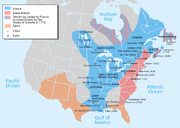
Map of the furthest extant of New France (in blue), about 1750
New France was the area colonized by France from the exploration of the Saint Lawrence River, by Jacques Cartier in 1534, to the cession of New French republic to Spain and Britain in 1763. Giovanni da Verrazzano had given the names Francesca and Nova Gallia to that state between New Spain (due east.g. Mexico) and English language Newfoundland (east.g. Canada), thus promoting French interests. [4] At its peak in 1712, the territory of New France extended from Newfoundland to Lake Superior and from the Hudson Bay to the Mississippi River and the Gulf of Mexico. The territory was then divided into five colonies, each with its own administration: Canada, Acadia, Hudson Bay, Newfoundland and Louisiana. Tens of thousands of French settlers came, and concentrated in villages along the St. Lawrence River, New Orleans and Acadia. The surface area around New Orleans and westward of the Mississippi passed to Spain, which ceded information technology to France in 1803, assuasive France to sell it equally the Louisiana Buy to the Usa.
Russian colonies [ ]
- Master article: Russian Alaska
The islands betwixt Russia and Alaska and the adjacent coastal areas on both sides of the Bering Bounding main were peopled by the Aleut, Yupik, Chukchi and related tribes. The Russian tsars decided to explore the eastern extant of their empire (and make up one's mind whether a land span existed between Asia and the Americas). This led to the Second Kamchatka trek in the 1730s and early 1740s. Exploration of the region led to exploitation of its resources - especially its furs, every bit other Russian regions became overexploited.
The showtime Russian colony in Alaska was founded in 1784 by Grigory Shelikhov.[v] The Russian-American Visitor was formed in 1799 with the influence of Nikolay Rezanov for the purpose of hunting sea otters for their fur. Later on, Russian explorers and settlers continued to establish trading posts in Alaska, the Aleutian Islands, British Columbia, Washington, Oregon and as far due south every bit Fort Ross in northern California. Fort Ross in what is now Sonoma County, California was the southernmost Russian colony in continental Due north America, and was a thriving settlement from 1812 to 1841.[6]
At the instigation of Secretarial assistant of State William H. Seward, the U.S. Senate approved the purchase of Alaska from the Russian Empire for 2 cents an acre, totaling $7,200,000 on April 9, 1867.
Russian missionaries such as Herman of Alaska established the Orthodox Church among the native tribes. The Orthodox Church and Alaska Natives continue to be closely associated.
In 1815, Dr. Schäffer, a Russian entrepreneur, went to Kauai and negotiated a treaty of protection with the island's governor Kaumualii, vassal of King Kamehameha I of Hawaii, but the Russian Tsar refused to ratify the treaty. See as well Orthodox Church in Hawaii and Russian Fort Elizabeth[1].
British colonies [ ]
England fabricated its first successful efforts at the start of the 17th century for several reasons. During this era, English language proto-nationalism and national assertiveness blossomed under the threat of Castilian invasion, assisted past a caste of Protestant militarism and adoration of Queen Elizabeth. At this time, however, at that place was no official attempt by the English regime to create a colonial empire. Rather, the motivation behind the founding of colonies was piecemeal and variable. Practical considerations, such as commercial enterprise, over-population and the desire for freedom of religion, played their parts. Over half of all European migrants to Colonial America arrived as indentured servants.[7]
Convict settlers [ ]
Between the tardily 1610s and the American Revolution, the British shipped an estimated l,000 convicts to its American colonies.[8] The first convicts to arrive pre-dated the inflow of the Mayflower .
Chesapeake Bay expanse [ ]
- Principal article: Jamestown, Virginia
The 1606 grants past James I to the London and Plymouth companies. The overlapping expanse (yellow) was granted to both companies on the stipulation that neither constitute a settlement within 100 miles (160 km) of each other. The location of the Jamestown Settlement is shown by "J"
Jamestown [ ]
The kickoff successful English colony was Jamestown, established in 1607, on a small river near Chesapeake Bay. The venture was financed and coordinated past the London Virginia Company, a articulation stock visitor looking for gold. Its kickoff years were extremely hard, with very high expiry rates from disease and starvation, wars with local Indians, and little gilded. The colony survived, barely, by turning to tobacco as a cash crop. By the tardily 17th century, Virginia's export economic system was largely based on tobacco, and new, richer settlers came in to take upward large portions of country, build big plantations and import indentured servants and slaves. In 1676, Salary's Rebellion occurred, merely was suppressed past royal officials. Afterward Bacon'south Rebellion, African slaves rapidly replaced English and Irish indentured servants as Virginia's main labor force.
The colonial assembly that had governed the colony since its establishment was dissolved, but was reinstated in 1630. It shared power with a royally appointed governor. On a more local level, governmental power was invested in county courts, likewise not elected. Every bit cash crop producers, Chesapeake plantations were heavily dependent on merchandise. With easy navigation past river, few towns and no cities developed; planters shipped directly to Great britain. High expiry rates and a very young population profile characterized the colony during its first years.
New England [ ]
- Main article: Connecticut Colony
Pilgrims [ ]
- Primary article: Pilgrims
The Pilgrims were a small Protestant sect based in England and the Netherlands. I group sailed on the Mayflower and settled in Massachusetts. After drawing up the Mayflower Compact by which they gave themselves broad powers of self-governance, they established the small Plymouth Colony in 1620; Plymouth afterward merged with the Massachusetts Bay colony. William Bradford was their primary leader. The Connecticut Colony was an English colony that became the U.Due south. state of Connecticut, although prior to 1664 it was claimed by the Dutch as part of New Netherland, with a 1623 settlement at Hartford, called Fort Goede Hoop, which pre-dates whatsoever English settlement in the state. Originally known every bit the River Colony, the colony was organized on March iii, 1636 every bit a haven for Puritan noblemen. Providence Plantation was founded in 1636 past Roger Williams, a theologian, Baptist preacher, and linguist on land gifted past the Narragansett sachem Canonicus. Roger Williams, fleeing from religious persecution in the Massachusetts Bay Colony, agreed with his boyfriend settlers on an egalitarian constitution providing for majority dominion "in civil things" and "freedom of conscience".
Puritans [ ]
- Master article: Puritans
The Puritans, a much larger group than the Pilgrims, established the Massachusetts Bay Colony in 1629 with 400 settlers. They sought to reform the Church of England by creating a new, pure church in the New Globe. Inside two years, an additional 2,000 settlers arrived. The Puritans created a deeply religious, socially tight-knit and politically innovative civilization that is however present in the modern United States[citation needed]. They hoped this new land would serve equally a "redeemer nation." Seeking the true religion, they fled England and in America attempted to create a "nation of saints" or the "City upon a Hill," an intensely religious, thoroughly righteous community designed to exist an example for all of Europe. Roger Williams, who preached religious toleration, separation of Church and State, and a complete break with the Church of England, was banished and founded Rhode Island Colony, which became a haven for other religious refugees from the Puritan community. Anne Hutchinson, a preacher of Antinomianism, besides was exiled to Rhode Island.
Economically, Puritan New England fulfilled the expectations of its founders. Unlike the cash-crop oriented plantations of the Chesapeake region, the Puritan economic system was based on the efforts of individual farmers, who harvested enough crops to feed themselves and their families and to trade for appurtenances they could non produce themselves. There was a mostly college economical continuing and standard of living in New England than in the Chesapeake. On the other hand, town leaders in New England could literally rent out the town's impoverished families for a year to anyone who could afford to board them, as a course of alms and as a form of cheap labor[citation needed]. Along with farming growth, New England became an of import mercantile and shipbuilding center, often serving every bit the hub for trading betwixt the South and Europe.
Eye Colonies [ ]
- Main article: Centre Colonies
The Center Colonies, consisting of the present-day states of New York, New Jersey, Pennsylvania, and Delaware, were characterized by a large degree of variety—religious, political, economic, and indigenous. The Dutch colony of New Netherland was taken over by the British and renamed New York but big numbers of Dutch remained in the colony. Many German language and Irish gaelic immigrants settled in these areas, likewise as in Connecticut. A large portion of the settlers who came to Pennsylvania were High german.
Lower Southward [ ]
The colonial Due south included the plantation colonies of the Chesapeake region (Virginia, Maryland, and, past some classifications, Delaware) and the lower South (Carolina, which somewhen split into North and South Carolina, and Georgia).
Carolinas [ ]
- Primary article: Province of Carolina
The first attempted English settlement s of Virginia was the Province of Carolina. It was a individual venture, financed by a grouping of English language Lords Proprietors, who obtained a Royal Charter to the Carolinas in 1663, hoping that a new colony in the s would become profitable similar Jamestown. Carolina was non settled until 1670, and fifty-fifty and then the first attempt failed because there was no incentive for emigration to the south. Even so, eventually the Lords combined their remaining capital and financed a settlement mission to the surface area led by John West. The trek located fertile and defensible basis at what was to become Charleston (originally Charles Boondocks for Charles Ii of England), thus beginning the English colonization of the mainland. The original settlers in Due south Carolina established a lucrative trade in provisions, deerskins and Indian captives with the Caribbean islands. They came mainly from the English language colony of Barbados and brought African slaves with them. Barbados, every bit a wealthy sugarcane plantation island, was one of the early English language colonies to use large numbers of Africans in plantation mode agriculture. The cultivation of rice was introduced during the 1690s via Africans from the rice-growing regions of Westward Africa. North Carolina remained a borderland through the early colonial catamenia.
At first, South Carolina was politically divided. Its ethnic makeup included the original settlers, a group of rich, slave-owning English settlers from the island of Barbados; and Huguenots, a French-speaking customs of Protestants. Near continuous borderland warfare during the era of King William's War and Queen Anne'southward State of war drove economic and political wedges between merchants and planters. The disaster of the Yamasee State of war, in 1715, set up off a decade of political turmoil. Past 1729, the proprietary government had collapsed, and the Proprietors sold both colonies back to the British crown.
Georgia [ ]
- Chief article: Province of Georgia
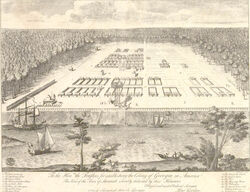
Savannah, Georgia Colony, Early on 1700's
James Oglethorpe, an 18th century British Member of Parliament, established Georgia Colony equally a common solution to two problems. At that time, tension between Espana and Great Britain was loftier, and the British feared that Spanish Florida was threatening the British Carolinas. Oglethorpe decided to found a colony in the contested border region of Georgia and populate it with debtors who would otherwise have been imprisoned according to standard British do. This program would both rid Great britain of its undesirable elements and provide her with a base from which to set on Florida. The showtime colonists arrived in 1733.
Georgia was established on strict moralistic principles. Slavery was forbidden, as was alcohol and other forms of supposed immorality. However, the reality of the colony was far from ideal. The colonists were unhappy well-nigh the puritanical lifestyle and complained that their colony could non compete economically with the Carolina rice plantations. Georgia initially failed to prosper, merely somewhen the restrictions were lifted, slavery was immune, and it became every bit prosperous as the Carolinas. The colony of Georgia never had a specific religion. It consisted of people of varied faiths.
East and West Florida [ ]
- Main article: East Florida
In 1763, Smashing United kingdom of great britain and northern ireland received East and W Florida from the Spanish. The Floridas remained loyal to Neat Britain during the American Revolution. They were returned to Espana in 1783 (in exchange for Havana), at which fourth dimension most Englishmen left. The Spanish so neglected the Floridas: few Spaniards lived there when the US bought the area in 1819.
Unification of the British colonies [ ]
A common defense [ ]
1 event that reminded colonists of their shared identity every bit British subjects was the War of the Austrian Succession (1740-1748) in Europe. This conflict spilled over into the colonies, where it was known as "King George'south War"; most of the fighting took place in Europe, British colonial troops attacked French Canada.
At the Albany Congress of 1754, Benjamin Franklin proposed that the colonies be united past a G Council overseeing a common policy for defense force, expansion, and Indian diplomacy. While the plan was thwarted past colonial legislatures and King George Ii, it was an early indication that the British colonies of North America were headed towards unification.
French and Indian War [ ]
George Washington during the French and Indian War
Benjamin Franklin's political cartoon calling for colonial unity during the French and Indian War; it would be used again during the American Revolution.
- Master article: French and Indian War
The French and Indian State of war (1754-1763) was the American extension of the general European conflict known as the Seven Years' State of war. While previous colonial wars in North America had started in Europe and then spread to the colonies, the French and Indian War is notable for having started in North America and and so spreading to Europe. Increasing contest betwixt Britain and France, specially in the Bully Lakes and Ohio valley, was i of the main origins of the war.
The French and Indian State of war took on a new significance for the North American colonists in Dandy Uk when William Pitt the elderberry decided that it was necessary to win the war against France at all costs. For the start fourth dimension, North America was one of the main theaters of what could be termed a "world war." During the war, the British Colonies' (including the thirteen colonies' that would after become the footing of the The states) position equally part of the British Empire was made truly credible, as British military and civilian officials took on an increased presence in the lives of Americans. The state of war also increased a sense of American unity in other ways. It acquired men, who might unremarkably have never left their own colony, to travel across the continent, fighting alongside men from incomparably unlike, yet still "American", backgrounds. Throughout the course of the war, British officers trained American ones (most notably George Washington) for battle--which would later benefit the American Revolution. Also, state legislatures and officials had to cooperate intensively, for arguably the start time, in pursuit of the continent-wide military endeavor.
Territorial changes post-obit the French and Indian War: land held by the British before 1763 is shown in red, land gained by Britain in 1763 is shown in pink.
In the Treaty of Paris (1763), France surrendered its vast Due north American empire to Britain. Earlier the war, Britain held the thirteen American colonies, nigh of present-twenty-four hours Nova Scotia, and about of the Hudson Bay watershed. Following the state of war, U.k. gained all French territory due east of the Mississippi River, including Quebec, the Great Lakes, and the Ohio valley. Britain also gained the Spanish colonies of East and Due west Florida. In removing a major foreign threat to the thirteen colonies, the state of war also largely removed the colonists' need of colonial protection.
The British and colonists triumphed jointly over a common foe. The colonists' loyalty to the mother country was stronger than always before. Nonetheless, disunity was beginning to class. British Prime Minister William Pitt the Elderberry had decided to wage the state of war in the colonies with the employ of troops from the colonies and tax funds from United kingdom itself. This was a successful wartime strategy, but later on the war was over, each side believed that it had borne a greater burden than the other. The British populace, the most heavily taxed of any in Europe, pointed out angrily that the colonists paid picayune to the royal coffers. The colonists replied that their sons had fought and died in a war that served European interests more than their own. This dispute was a link in the chain of events that soon brought about the American Revolution.
Ties to the British Empire [ ]
Although the colonies were very different from one another, they were all the same a part of the British Empire in more than merely name.
Socially, the colonial aristocracy of Boston, New York, Charleston, and Philadelphia saw their identity equally British. Although many had never been to England, they imitated British styles of dress, trip the light fantastic toe, and etiquette. This social upper echelon congenital its mansions in the Georgian style, copied the furniture designs of Thomas Chippendale, and participated in the intellectual currents of Europe, such equally Enlightenment. To many of their inhabitants, the seaport cities of colonial America were truly British cities.
Many of the political structures of the colonies drew upon various English language political traditions, most notably the Commonwealthmen and the Whig traditions. Many Americans at the fourth dimension saw the colonies' systems of governance as modeled afterward the British constitution of the fourth dimension, with the male monarch corresponding to the governor, the House of Commons to the colonial assembly, and the Business firm of Lords to the Governor's council. The codes of law of the colonies were oft drawn directly from English language police; indeed, English mutual law survives not only in Canada, just even in the mod United States. Eventually, it was a dispute over the meaning of some of these political ideals, especially political representation, and a growing unity amid the new generations that led to the American Revolution.
Another bespeak on which the colonies found themselves more similar than different was the booming import of British goods. The British economy had begun to grow rapidly at the end of the 17th century, and by the mid-18th century, small factories in United kingdom of great britain and northern ireland were producing much more than the nation could consume. Finding a market for their goods in the British colonies of N America, Great britain increased her exports to that region past 360% between 1740 and 1770. Because British merchants offered generous credit to their customers, Americans began buying staggering amounts of English appurtenances. From Nova Scotia to Florida, all British subjects bought similar products, creating and anglicizing a sort of common identity.
From unity to revolution [ ]
Regal Annunciation [ ]
The general sentiment of inequity that arose soon afterwards the Treaty of Paris was solidified by the Regal Announcement of 1763, which temporarily prohibited settlement west of the Appalachian Mountains. Colonists resented the measure, and it was never enforced.
Acts of Parliament [ ]
Parliament had generally been preoccupied with affairs in Europe and let the colonies govern themselves. It was no longer willing to practice so. A series of measures resulting from this policy alter, while affecting the New England colonies most directly would continue to arouse opposition in the 'thirteen colonies' over the next thirteen years:
- Currency Act (1764)
- Sugar Act (1764)
- Postage Act 1765
- First Quartering Act (1765)
- Declaratory Human activity (1766)
- Townshend Revenue Human action (1767)
- Tea Act (1773)
- The Intolerable Acts, also called the Coercive or Punitive Acts
- Second Quartering Act (1774)
- Quebec Act (1774)
- Massachusetts Government Human action (1774)
- Administration of Justice Deed (1774)
- Boston Port Act (1774)
- Prohibitory Act (1775)
Colonial life [ ]
New England [ ]
In New England, the Puritans created self-governing communities of religious congregations of farmers, or yeomen, and their families. High-level politicians gave out plots of land to male settlers, or proprietors, who then divided the land amongst themselves. Large portions were normally given to men of college social standing, simply every white homo had enough state to support a family. Also important was the fact that every white human had a voice in the boondocks meeting. The town meeting levied taxes, built roads, and elected officials to manage boondocks affairs.
The Congregational Church building, the church the Puritans founded, was not automatically joined past all New England residents because of Puritan behavior that God singled out only a few specific people for conservancy. Instead, membership was limited to those who could assuredly "examination" before members of the church that they had been saved. They were known as "the elect" or "Saints" and fabricated up less than xl% of the population of New England.
Farm life [ ]
A bulk of New England residents were small farmers. Within these small farm families, and English language families as well, a man had complete ability over the property and his married woman. When married, an English woman lost her maiden proper name and personal identity, pregnant she could non own holding, file lawsuits, or participate in political life, even when widowed. The function of wives was to raise and nurture salubrious children and back up their husbands. Nigh women carried out these duties. In the mid-18th century, women ordinarily married in their early 20s and had 6 to viii children, most of whom survived to adulthood. Farm women provided about of the materials needed past the residuum of the family past spinning yarn from wool and knitting sweaters and stockings, making candles and soap, and churning milk into butter.
long-term economic growth
Most New England parents tried to help their sons found farms of their own. When sons married, fathers gave them gifts of state, livestock, or farming equipment; daughters received household goods, farm animals, and/or cash. Arranged marriages were very unusual; normally, children chose their own spouses from inside a circle of suitable acquaintances who shared their religion and social standing. Parents retained veto power over their children'due south marriages.
New England farming families generally lived in wooden houses considering of the abundance of trees. A typical New England farmhouse was one-and-a-one-half stories alpine and had a strong frame (commonly made of large square timbers) that was covered by wooden clapboard siding. A large chimney stood in the middle of the business firm that provided cooking facilities and warmth during the winter. One side of the ground flooring contained a hall, a general-purpose room where the family worked and ate meals. Adjacent to the hall was the parlor, a room used to entertain guests that contained the family unit's best furnishings and the parent's bed. Children slept in a loft higher up, while the kitchen was either function of the hall or was located in a shed forth the back of the house. Because colonial families were large, these minor dwellings had much activeness and in that location was trivial privacy.
By the middle of the 18th century, this way of life was facing a crisis as the region's population had virtually doubled each generation—from 100,000 in 1700 to 200,000 in 1725, to 350,000 by 1750—because farm households had many children, and most people lived until they were 60 years old. Equally colonists in Massachusetts, Connecticut, and Rhode Island continued to subdivide their land between farmers, the farms became too small to support single families. This overpopulation threatened the New England platonic of a society of independent yeoman farmers.
Some farmers obtained land grants to create farms in undeveloped country in Massachusetts and Connecticut or bought plots of land from speculators in New Hampshire and what later became Vermont. Other farmers became agronomical innovators. They planted nutritious English grass such equally red clover and timothy-grass, which provided more feed for livestock, and potatoes, which provided a loftier production rate that was an advantage for minor farms. Families increased their productivity by exchanging goods and labor with each other. They loaned livestock and grazing land to one another and worked together to spin yarn, sew quilts, and shuck corn. Migration, agricultural innovation, and economic cooperation were artistic measures that preserved New England's yeoman society until the 19th century.
Town life [ ]
Saltbox-style homes originated in New England after 1650
By the mid eighteenth century in New England, shipbuilding was a staple. The British crown often turned to the inexpensive, all the same strongly built American ships. There was a shipyard at the oral cavity of almost every river in New England.
By 1750, a variety of artisans, shopkeepers, and merchants provided services to the growing farming population. Blacksmiths, wheelwrights, and article of furniture makers set upwardly shops in rural villages. There they congenital and repaired goods needed by subcontract families. Stores selling English articles such as material, iron utensils, and window glass likewise every bit West Indian products similar saccharide and molasses were set up up past traders. The storekeepers of these shops sold their imported appurtenances in exchange for crops and other local products including roof shingles, potash, and barrel staves. These local goods were shipped to towns and cities all along the Atlantic Coast. Enterprising men prepare stables and taverns along wagon roads to service this transportation system.
Afterward these products had been delivered to port towns such as Boston and Salem in Massachusetts, New Oasis in Connecticut, and Newport and Providence in Rhode Island, merchants then exported them to the Due west Indies where they were traded for molasses, saccharide, aureate coins, and bills of exchange (credit slips). They carried the Westward Indian products to New England factories where the raw carbohydrate was turned into granulated and sugar and the molasses distilled into rum. The golden and credit slips were sent to England where they were exchanged for manufactures, which were shipped dorsum to the colonies and sold along with the sugar and rum to farmers.
Other New England merchants took advantage of the rich fishing areas along the Atlantic Declension and financed a large fishing fleet, transporting its take hold of of mackerel and cod to the Due west Indies and Europe. Some merchants exploited the vast amounts of timber forth the coasts and rivers of northern New England. They funded sawmills that supplied cheap forest for houses and shipbuilding. Hundreds of New England shipwrights built oceangoing ships, which they sold to British and American merchants.
Many merchants became very wealthy by providing their appurtenances to the agronomical population and ended up dominating the social club of sea port cities. Unlike yeoman farmhouses, these merchants resembled the lifestyle of that of the upper class of England living in elegant 2-and-a-one-half story houses designed the new Georgian style. These Georgian houses had a symmetrical façade with equal numbers of windows on both sides of the central door. The interior consisted of a passageway down the middle of the business firm with specialized rooms such as a library, dining room, formal parlour, and master sleeping room off the sides. Unlike the multi-purpose halls and parlours of the yeoman houses, each of these rooms served a separate purpose. In a Georgian house, men mainly used certain rooms, such as the library, while women mostly used the kitchen. These houses independent bedrooms on the second floor that provided privacy to parents and children.
Culture and education [ ]
Massachusetts Hall, oldest surviving building at Harvard University, built 1718-1720 equally a dormitory
- Chief commodity: Education in Colonial America
Elementary didactics was widespread in New England. Early Puritan settlers believed information technology was necessary to report the Bible, so children were taught to read at an early age. It was also required that each boondocks pay for a chief schoolhouse. Well-nigh 10 pct enjoyed secondary schooling and funded grammer schools in larger towns. Most boys learned skills from their fathers on the farm or every bit apprentices to artisans. Few girls attended formal schools, but about were able to get some teaching at dwelling house or at so-chosen "Dame schools" where women taught basic reading and writing skills in their own houses. Past 1750, well-nigh 90% of New England's women and most all of its men could read and write. Many churches in New England established colleges to railroad train ministers while Puritans founded many places of college learning such as Harvard College in 1636 and Yale College in 1701. Later, Baptists founded Rhode Isle College (virtually Brown University) in 1764 and a Congregationlist minister established Dartmouth College in 1769. Great Britain also founded schools, such as the College of William and Mary in 1693. Few people (no women and a minor number of men) attended college, making higher pedagogy available only for wealthy merchant families.
New England produced many great literary works. In fact, more than works were created in New England than all of the other colonies combined. Most of these works were histories, sermons, and personal journals, and were written by ministers or inspired by religious beliefs. Cotton Mather, a Boston minister published Magnalia Christi Americana (The Bully Works of Christ in America, 1702), while revivalist Jonathan Edwards wrote his philosophical work, A Careful and Strict Inquiry Into...Notions of...Freedom of Will... (1754). Virtually music had a religious theme too and was mainly the singing of Psalms. Because of New England's deep religious beliefs, artistic works that were not very religious or as well "worldly" were banned. These endeavors included drama and other types of plays.
Faith [ ]
Some migrants who came to Colonial America were in search of the liberty to practice forms of Christianity which were prohibited and persecuted in Europe. Since there was no country faith, and since Protestantism had no central authorisation, religious practice in the colonies became diverse.
One attempt to consolidate religious practice is sometimes called the Dandy Awakening , a controversial term which refers to a northeastern Protestant revival movement that took place in the 1730s and 1740s. The motility began with Jonathan Edwards, a Massachusetts preacher who sought to render to the Pilgrims' strict Calvinist roots and to reawaken the "Fear of God." English preacher George Whitefield and other afoot preachers connected the move, traveling beyond the colonies and preaching in a dramatic and emotional style. Followers of Edwards and other preachers of similar religiosity called themselves the "New Lights", equally contrasted with the "Former Lights", who disapproved of their movement. To promote their viewpoints, the two sides established academies and colleges, including Princeton and Williams Higher. The Swell Awakening has been chosen the starting time truly American outcome.[9]
A similar pietistic motion took place among some of the German and Dutch Lutherans, leading to internal dvisions. By the 1770s, the Baptists were growing apace both in the north (where they founded Brown University, and in the South (where they challenged the previously unquestioned moral authorization of the Anglican establishment).
Mid-Atlantic Region [ ]
Unlike New England, the Mid-Atlantic Region gained much of its population from new immigration, and by 1750, the combined populations of New York, New Bailiwick of jersey, and Pennsylvania had reached most 300,000 people. By 1750, nearly 60,000 Irish and fifty,000 Germans came to live in British Northward America, many of them settling in the Mid-Atlantic Region. William Penn, the human being who founded the colony of Pennsylvania in 1682, attracted an influx of immigrants with his policies of religious liberty and freehold buying. "Freehold" meant that farmers owned their state gratuitous and articulate of leases. The first major influx of immigrants came mainly from Republic of ireland and consisted of Irish Presbyterians and Irish gaelic Catholics. A smaller immigration came with Germans trying to escape the religious conflicts and declining economic opportunities in Germany and Switzerland.
Ways of life [ ]
Much of the architecture of the Centre Colonies reflects the diversity of its peoples. In Albany and New York City, a majority of the buildings were Dutch mode with brick exteriors and loftier gables at each finish while many Dutch churches were shaped liked an octagon. Using cutting stone to build their houses, German and Welsh settlers in Pennsylvania followed the way of their homeland and completely ignored the plethora of timber in the area. An case of this would be Germantown, Pennsylvania where 80 percentage of the buildings in the town were made entirely of stone. On the other hand, settlers from Republic of ireland took reward of America's ample supply of timber and constructed sturdy log cabins.
Indigenous cultures also affected the styles of furniture. Rural Quakers preferred elementary designs in effects such as tables, chairs, chests and shunned elaborate decorations. However, some urban Quakers had much more elaborate furniture. The city of Philadelphia became a major center of furniture-making considering of its massive wealth from Quaker and British merchants. Philadelphian chiffonier makers built elegant desks and highboys. German artisans created intricate carved designs on their chests and other furniture with painted scenes of flowers and birds. German language potters also crafted a large array of jugs, pots, and plates, of both elegant and traditional design.
There were ethnic differences in the treatment of women. Amidst Puritan settlers in New England, wives virtually never worked in the fields with their husbands. In German communities in Pennsylvania, notwithstanding, many women worked in fields and stables. High german and Dutch immigrants granted women more than control over property, which was non permitted in the local English law. Unlike English language colonial wives, German and Dutch wives owned their own apparel and other items and were also given the power to write wills disposing of the holding brought into the marriage.
By the fourth dimension of the Revolutionary War, approximately 85 per cent of white Americans were of English, Irish gaelic, Welsh, and Scottish descent. Approximately 8.8 per cent of whites were of German ancestry, and 3.v per cent were of Dutch origin.
Farming [ ]
Ethnicity fabricated a divergence in agricultural exercise. Equally an example, German farmers mostly preferred oxen rather than horses to pull their plows and Scots-Irish fabricated a farming economy based on hogs and corn. In Ireland, people farmed intensively, working small pieces of state trying to become the largest possible production-charge per unit from their crops. In the American colonies, settlers from northern Ireland focused on mixed-farming. Using this technique, they grew corn for human being consumption and as feed for hogs and other livestock. Many improvement-minded farmers of all different backgrounds began using new agricultural practices to enhance their output. During the 1750s, these agricultural innovators replaced the mitt sickles and scythes used to harvest hay, wheat, and barley with the cradle scythe, a tool with wooden fingers that bundled the stalks of grain for easy collection. This tool was able to triple the amount of work down by farmers in one day. Farmers also began fertilizing their fields with dung and lime and rotating their crops to go on the soil fertile.
Before 1720, almost colonists in the mid-Atlantic region worked with pocket-size-calibration farming and paid for imported manufactures past supplying the West Indies with corn and flour. In New York, a fur-pelt consign trade to Europe flourished adding additional wealth to the region. Later 1720, mid-Atlantic farming stimulated with the international demand for wheat. A massive population explosion in Europe brought wheat prices upward. By 1770, a bushel of wheat price twice as much as it did in 1720. Farmers also expanded their production of flaxseed and corn since
- ↑ "colonial", Merriam-Webster'southward Online Lexicon. Accessed on line October 17, 2007.
- ↑ Colonial North America
- ↑ Colonial America 1600-1775
- ↑ 1524: The voyage of discoveries, Centro studi storici Verrazzano
- ↑ Meeting of Frontiers: Alaska - The Russian Colonization of Alaska
- ↑ Russian Settlement at Fort Ross, California, in the 19th Century
- ↑ Indentured Servitude in Colonial America, Deanna Barker, Borderland Resources
- ↑ Template:Cite web
- ↑ Template:Cite journal
Source: https://arw.fandom.com/wiki/Colonial_history_of_the_United_States
0 Response to "Records of the Gates Families of America From the Colonial Period"
Postar um comentário